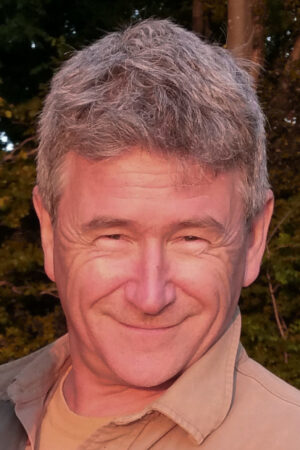
Rob Stuart, Utrecht-based integrative therapist/counselor
Not until the age of 50 did I find my true vocation: to work as a therapist. Since my childhood, people had often opened up to me about their problems, sensing they would be taken seriously on their own terms and not (pre-)judged. Now 68, I have 14 years of experience working with individual adults and couples in love relationships.
The therapist’s core quality is empathy: sensing the essence of his clients’ cognitive stumbling blocks and emotional suffering, then working with them to enable them to transform their problems into opportunities for success, fulfilment and happiness. An effective therapist has the requisite knowledge, experience, insight and decisiveness to guide clients of diverse personalities and backgrounds in moving towards their goals.
Rather than a ‘professionally distant’ clinician, I believe that stuck and suffering people need a fellow traveller who isn’t averse to pain and darkness, who warmly listens, and who encourages healing, learning and growth. They need to be understood on their own terms by a caregiver who speaks from the heart with a clear vision of what he sees and senses in them, confronts them when necessary but never judges them. Judgment obstructs self-empathy and self-discovery. Increasingly, my head-and-heart work focuses on learning to love and care for yourself rather than clinical ‘diagnosis and treatment’.
Born in Yorkshire in 1958, I grew up in Warwickshire — Shakespeare and Tolkien country. Partly through the example of my parents, who worked for others’ welfare, I learned that what makes people tick and what hold them back are far more interesting than competing to ‘win’. That essential lesson was reinforced by the negative example of the traditional, elitist boys’ school I attended, which was all about competition. Far from being warm, empathetic and nurturing, it was cold, repressive and disciplinarian — with frequent psychological and physical punishments. Raised to be ‘a good Christian’, I awoke from theism at age 13, though the compassionate and non-violent life story of Jesus continued to inspire me. In my teens, I learned from prominent English socialists such as George Orwell and Tony Benn that solidarity with others and working for the common good is what gives life dignity and meaning.
I first came to the Netherlands in 1980, having failed the final year of my engineering degree — because I was too busy partying! Youth is wasted on the young. Unemployment was rife in the not-so-United Kingdom under Margaret Thatcher, but work was up for grabs here in the Netherlands. With its open-minded and tolerant attitudes, it seemed to be the land of milk and honey. I had planned to save money and travel overland to India. However, I was sidetracked by love, falling for an enticing and intriguing young Dutch woman who was more interested in Africa. We soon discovered a shared desire to work in what was then called ‘Third World development’. This motivated me to return to England and complete my engineering degree cum laude. We then travelled overland across Africa for nine months before working for three years at a technical secondary school in stunning northern Tanzania, at the foot of Mount Kilimanjaro.
Living and working there was very challenging, with daily dilemmas. Widespread poverty, corruption, rivalry and suspicion stifled cooperation and progress, and there was a pervasive threat of violence. To cut a long story short, I returned to Utrecht in the late 1980s, culture-shocked, disillusioned with humanity and our relationship in terminal crisis.
Suffering from ‘a nervous breakdown’ – anxiety, depression, insomnia and suicidal ideations – I was off work for 18 months. Weekly group therapy with Hans Knibbe (founder of Utrecht’s School voor Zijnsoriëntatie) enabled me to get in touch with and release pent-up emotions. Thanks to bio-energetics, psychodrama, guided imagery and Gestalt, I gradually came home to my real self and felt grounded and present in the here and now again. In later stages of my long and convoluted healing journey, transactional analysis, mindfulness and integrative psychotherapy proved to be effective. From my struggles with anxiety and depression, I know how awful and lonely it can be to struggle mentally and emotionally, to feel desperate and powerless, and to urgently need a caregiver who understands you and can get you moving in a positive direction.
After recovering my balance and vitality, I tried various professions for nearly 20 years, including technical writing, public relations, translating and editing, radio journalism, human rights work, and general and academic English teaching. Despite my successes, however, vocation and passion were sadly lacking. Not until I was 50 did it suddenly dawn on me that I wanted to become a therapist. The trigger was the stab of envy I felt when a girlfriend told me she was going to train as an integrative therapist. I suddenly had a mission again. I realised that the challenging and painful experiences I had been through had just been preparing me for this!
In 2012, I completed my professional training at the Nederlandse Academie voor Psychotherapie in Amsterdam. It was a very difficult but enormously enriching learning experience, which gave my personal development a great impulse. I then did a one-year course in integrative relationship therapy.
Since opening my independent private practice for integrative therapy and counseling in Utrecht, I have accumulated thousands of hours of experience guiding adult individuals and couples with all kinds of problems through self-discovery, healing and growth. I find it hugely rewarding and deeply moving to see fellow travellers positively transforming their anxieties, inner conflicts and demoralisation into calm self-confidence and empowerment. They achieve minor and major personal revolutions through courageous and honest self-exploration and by harnessing the self-healing power of the human psyche. If they can do it, so can you!